

Key Highlights:
- Nonverbal autism communication means a child expresses needs through gestures, sounds, pictures, or devices instead of spoken words.
- About 25–30% of children with autism remain minimally verbal, but tools like AAC, PECS, and sign language can build strong functional communication.
- ABA therapy teaches these skills step by step, reducing frustration and increasing independence.
When a child with autism is not talking, every day can feel confusing. You may watch them pull your hand, cry, or shut down and still feel unsure what they are trying to say. Nonverbal autism communication is not a lack of communication. It is communication that happens through movement, sounds, pictures, devices, and behavior instead of spoken words.
In this article, you will see how ABA therapy services break down communication into small steps, use tools such as AAC devices and PECS, and teach families practical strategies they can use at home
What Is Nonverbal Autism Communication?
Nonverbal autism communication describes how a child with autism expresses themself when spoken words are limited or missing. Many children in this group are better described as minimally verbal. They may use a few single words or short phrases, but speech does not cover their daily needs.
Research suggests that about 25–30 percent of children with autism do not develop functional spoken language and remain minimally verbal beyond early childhood. This is a sizable subgroup, and their communication abilities are varied. Some children use:
- Gestures and pointing to request items or show interest
- Eye gaze and facial expressions to accept, refuse, or share emotions
- Sounds and vocalizations that carry meaning in context
Others may communicate through patterns of behavior, such as leading an adult to the kitchen when hungry or pushing away items they do not want. These actions are still communication, even when they are hard to interpret.
How Does ABA Therapy Build Communication for Nonverbal Children?
ABA therapy starts by finding out how your child already communicates. A BCBA looks at gestures, sounds, eye contact, and behavior to see what your child is “saying” now and what gets in the way of clearer communication.
From there, ABA communication goals are set around functional skills such as:
- Requesting basic needs like food, help, and breaks
- Responding to simple questions or directions
- Letting adults know “yes,” “no,” and “stop”
- Sharing comments about things they enjoy
Functional Communication Training (FCT) is often a central strategy. FCT teaches a child to replace challenging behaviors with a more acceptable communication response that serves the same purpose. For example, instead of screaming when a TV show ends, a child might learn to hand over a “more TV” picture or press a button that says “more cartoons.”
ABA therapists break each skill into small, practiceable steps and use prompts, modeling, and positive reinforcement. Over time, prompts fade, allowing your child to communicate more independently.
A recent meta-analysis of early interventions for young children with autism found that targeted programs can produce meaningful gains in social communication, especially when started in the preschool years.
AAC Devices: Giving Every Child a Voice
Augmentative and alternative communication (AAC) is the broad term for tools that add to or replace speech. AAC devices support children who have trouble using spoken language.
AAC options include:
- No-tech / low-tech tools such as picture cards, communication boards, or written words
- High-tech AAC devices, such as dedicated speech-generating devices
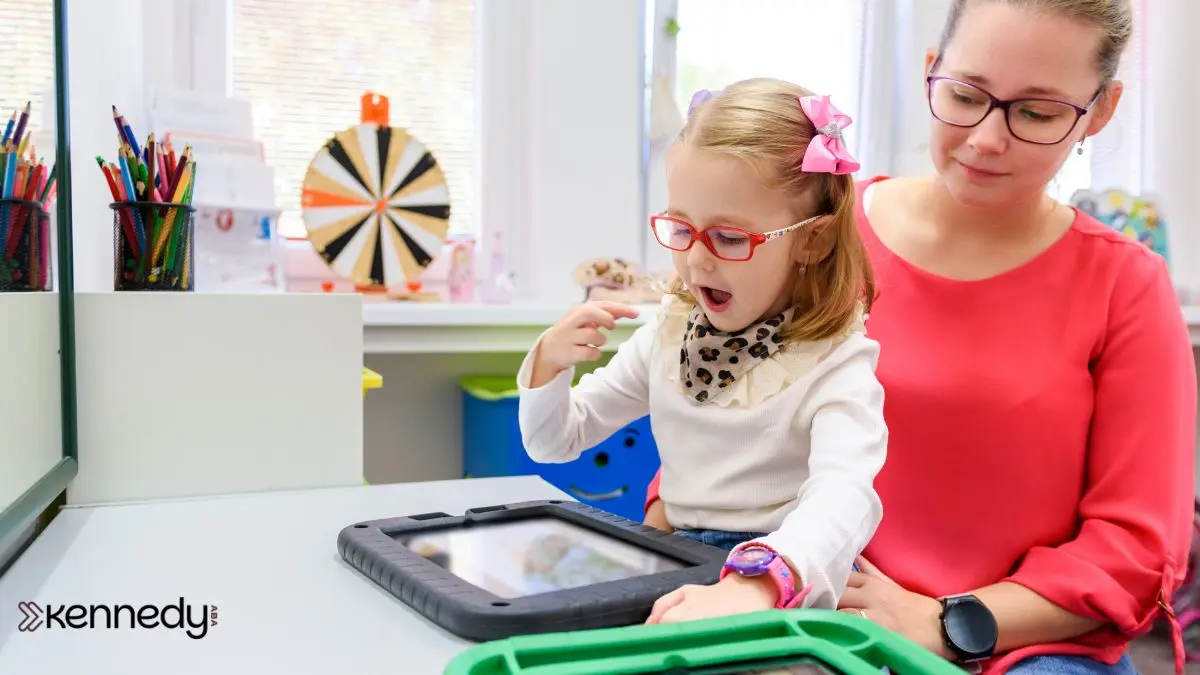
- Communication apps on tablets or phones that speak when a child taps symbols
AAC devices can be customized with photos, symbols, and words that match the child’s home routines. ABA teams and speech-language pathologists often work together to choose a system based on motor skills, attention, and understanding.
Many families worry that AAC will stop a child from talking. Long-term reviews of AAC interventions show the opposite. Across 27 studies, none of the participants lost speech, 11 percent showed no change, and 89 percent increased speech after AAC was introduced.
The PECS System: Starting Simple, Building Fast
The Picture Exchange Communication System (PECS system) is a structured way to teach picture-based communication. A child learns to hand a picture to another person to get something they want, rather than pointing or reaching.
PECS usually unfolds in six phases:
- Single picture exchange, so the child learns that giving a picture makes something happen
- Increasing distance and partners, so the child seeks out someone to communicate with
- Picture discrimination so the child chooses between pictures for different items
- Simple sentences using a strip like “I want + cookie”
- Answering questions such as “What do you want?”
- Commenting on things in the environment, like “I see car”
Studies and meta-analyses report that PECS can improve requesting and sometimes support growth in spoken language for children with autism.
In ABA therapy, PECS is often introduced early because it teaches children to initiate communication rather than waiting for an adult prompt. Therapists then work with caregivers and teachers so picture exchange is available in home, school, and community settings.
Sign Language for Autism: A Natural Bridge to Communication
Some children with autism respond well to sign language as an early communication option. Signs are visual, motor-based, and do not require equipment. For some children, a simple sign such as “more,” “help,” or “all done” is faster and easier than forming words.
Research reviews show that sign language can increase expressive communication for many children on the spectrum, and in some cases, supports later spoken language as well.
In ABA programs, teams may use:
- Full ASL signs when families already know or want to learn sign language
- Key word signing for a smaller set of high-impact signs
- Signs alongside AAC tools so the child always has at least one way to respond
The choice depends on motor skills, visual attention, and family comfort. What’s more important is consistency. When adults around the child use the same signs in the same situations, the child has more chances to practice and be understood.

Communication Apps for Everyday Life
Communication apps turn tablets and phones into portable AAC devices. Many apps use picture symbols that speak aloud when tapped. For a child on the spectrum, this can make participation easier at the grocery store, on the playground, or in a restaurant.
Common features of communication apps include:
- Customizable symbol pages for home, school, and community
- Speech-generating output so others can hear the child’s message
- Visual scenes or photo-based pages for children who respond best to real images
ABA teams can help families decide whether a robust communication app, a simpler picture exchange system, or a mix of both makes sense. The best system is one that feels usable at home, in school, and wherever the child spends time.
Parent Training and Home Practice for Nonverbal Communication
Communication gains are strongest when families are active partners. ABA programs that support nonverbal autism communication often include structured parent training. Parents learn to use the same AAC devices, PECS pictures, or signs the child uses in sessions.
Parent training often includes how to:
- Offer choices instead of guessing needs, so the child has a reason to communicate
- Pause after giving a direction or question, giving extra processing time
- Respond right away when the child uses a new communication skill
- Use aided language stimulation by pointing to symbols on a device while speaking
When families practice these autism communication strategies in daily routines, communication stops being a “therapy activity” and becomes part of regular life.
What Progress Looks Like in Communication Over Time
Progress in nonverbal autism communication does not look the same for every child. Some children move from gestures to pictures to spoken words. Others rely on AAC or sign language long-term and build rich, meaningful communication that way.
Important signs of growth include:
- More independent requests, such as asking for a break without crying
- New communication functions, like commenting or saying “no,” not just requesting
- Use of tools across places, from home to school to the community
Early and well-designed interventions can support gains in social communication, one of the benefits of ABA therapy. A large meta-analysis of early autism interventions found significant effects on social communication outcomes in young children, with the strongest gains around preschool age.
FAQs About Nonverbal Communication in Autism
How does nonverbal autism communication show up day to day?
Nonverbal autism communication shows up day to day through consistent non-speech signals, including leading an adult by the hand, pointing or repeated glances toward a wanted item, pushing away unwanted food, and using facial expressions, posture changes, or meaningful vocalizations.
Can a child with nonverbal autism learn to speak?
Yes, a child with nonverbal autism can learn to speak because many children gain spoken language with early, consistent support. Research on severe language delay found that about 70% of children with only a few words at age 4 reached phrase or fluent speech by age 8, while others rely on AAC.
What should you avoid when supporting a nonverbal child with autism?
Support for a nonverbal child with autism avoids removing communication opportunities, forcing speech-only expectations, and dismissing AAC, gestures, or pictures as “not real” communication. Consistent support also avoids frequent tool changes, because stable systems like PECS or an AAC device across home, school, and community increase successful communication and reduce frustration.
Support Your Child’s Communication Journey
Children with autism communicate in many ways, and spoken words are only one of them. In this article, you have seen how ABA therapy uses PECS, AAC devices, sign language, communication boards, and everyday routines to grow nonverbal autism communication into clearer, more independent skills.
Kennedy ABA provides in-home and community-based ABA therapy for children with autism across North Carolina, Georgia, and Virginia, with a strong emphasis on functional communication, AAC support, and parent training.
If you are ready to explore more options for your child’s communication, reach out to our team. Together, we can look at your child’s current strengths, choose tools that match your family’s routines, and build a plan that helps your child share more of who they are.